Starting from scratch: Te Rōpu Poa leads Whānau Ora into its most contested era

Te Rōpu Poa is the new chief executive of Rangitāmiro. (Image: Supplied. Additional design: The Spinoff).
Te Rōpu Poa is guiding Rangitāmiro – the new Whānau Ora agency for the upper North Island – through a political storm and wants a future shaped by whānau.
When she was young, Te Rōpu Poa attended a fundraiser for her netball team at Northland College in Kaikohe. While her friends all had cakes and other baked goods to sell, Poa was given a sack of tuna by her grandfather and rēwana bread by her grandmother. “I was embarrassed – yet they were the first things that went,” Poa tells me. Now in her late fifties, the grandmother of three says that experience taught her to be proud of who she is.
Poa is a month into her new role as chief executive of Rangitāmiro, the recently minted Whānau Ora commissioning agency for region one, stretching from the far north to Taupō. There are four regions in total – areas with a commissioning agency responsible for contracting service providers. Region two extends from Taupō to Wellington, region three is the entire South Island, and region four is the entire country, with services specifically for the Pasifika community.
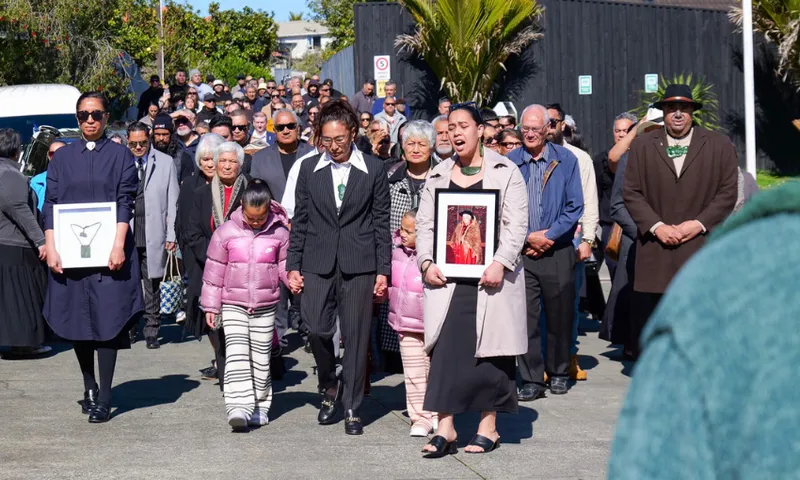
Rangitāmiro is a joint venture between the National Hauora Coalition (where Poa was a director prior to her new role), Ngaa Pou Hauora oo Taamaki Makaurau and Te Tiratū Iwi Māori Partnership Board. Last month, approximately 200 people gathered at Te Mahurehure Marae in Point Chevalier for a formal welcome for Poa into her new role. The crowd included several prominent leaders from around Te Tai Tokerau and the upper North Island, indicating the importance of Poa’s new position within the Māori community. With Poa and Rangitāmiro controversially replacing the John Tamihere-led Whānau Ora Commissioning Agency, many will be waiting with bated-breath to see what direction Whānau Ora heads in under her leadership.
Whānau ora is a government programme dedicated to delivering social and health services to whānau Māori and Pasifika around Aotearoa (see here for a full primer on the origins of Whānau Ora and the recent overhaul). Whānau Ora has a broad remit that allows for flexibility, but also opens itself up to criticism – particularly when money is being spent on investments in Super Rugby teams and electoral roll marketing campaigns.
In Budget 2024, $180m was allocated to Whānau Ora over four years. Funds were previously divided across three regions based on the distribution of the Māori descent population by Māori electoral regions. However, this has now changed to be based on the social deprivation index data collected in Census 2023. Regardless, each region has its own commissioning agency and for the last decade, three commissioning agencies have controlled funds for their respective regions.
However, in March this year, news broke that the three incumbent commissioning agencies – The Whānau Ora Commissioning Agency (formerly Te Pou Matakana), Te Pūtahitanga o Te Waipounamu and Pasifika Futures – would not be having their contracts renewed. What followed can only be described as pandemonium.
Former Labour minister for Whānau Ora Peeni Henare warned services could end up in the hands of large, foreign-owned, non-Māori organisations. Chief executive of the Whānau Ora Commissioning Agency and Te Pāti Māori president John Tamihere called it a “political attack on the very existence of Māori-led solutions” and labelled the changes as “totalitarianism”. There were reports that hundreds of jobs were at risk due to the changes and there would be “major disruptions to services throughout the country” as a result of the changes.
The changes have led to job losses at all the previous commissioning agencies. However, Poa says agencies such as The Whānau Ora Commissioning Agency have picked up contracts to continue providing services throughout the transitional period over the next 12 months. She also says there have not been any major disruptions to services for whānau.
A decade ago, Poa was the regional director for Te Tai Tokerau at Te Puni Kōkiri and had worked as chief executive of Te Hau Ora Ō Ngāpuhi, a subsidiary of Te Rūnanga-Ā-Iwi-Ō-Ngāpuhi charged with leading the health strategy for Ngāpuhi. In her role with Te Puni Kōkiri, Poa was responsible for contracting and allocating funding to service provider collectives in the region when the transition to a Whānau Ora commissioner model began. She likens that transition to the one she is now overseeing as chief executive of Rangitāmiro.
“At the beginning, people were feeling that this was not sustainable. They were feeling quite uncomfortable about the change and what that transition looked like,” Poa says.
One of the biggest challenges so far has been the resistance from the Whānau Ora Commissioning Agency to work collaboratively with Rangiatāmiro. When the announcement was made that The Whānau Ora Commissioning Agency would not be having its contract renewed, Tamihere said the agency would not be helping the new commissioning agency that would replace it in any way.
“This is a challenge. You have got strong personalities in leadership. You have got big groups and big organisations who have had the same thing for the last 20 years,” says Poa. “We’re not getting anything from anywhere, so we are starting pretty much from scratch.”
The Whānau Ora Commissioning Agency requested a judicial review of the procurement process led by Te Puni Kōkiri and claimed the potential disruption to services was a breach of Article 2 of the Treaty of Waitangi. The Courts rejected the agency’s appeals and for Poa, the legal crusade led by Tamihere left a sour taste.
“Don’t pick and choose between Pākehā law and tikanga when it suits,” she says. “Our traditions are for collective resolution and closure, and they will always prevail if we uphold them with integrity,” Poa says.
When asked why she thought Rangitāmiro was the government’s preferred choice for region one, Poa says she believed minister for Whānau Ora Tama Potaka was simply looking for change. “It’s pretty standard practice for the government to conduct and undertake procurement processes after five years,” Potaka said at the time, highlighting the previous commissioning agencies had overseen a “10-year stint”.
Despite the criticism of the government’s decision and resistance from some, Poa is excited to be leading Rangitāmiro into a new phase of Whānau Ora. For her, Whānau Ora is about “doing the right thing by whānau”. This involves a focus on the long term sustainability of the communities they serve and influencing legislation, citing the repeal of section 7AA of the Oranga Tamariki Act 1989 and building papakāinga on Māori land as examples where she would like to have some influence on policy.
Poa acknowledges the deep deprivation and structural challenges facing whānau in Te Tai Tokerau are different to the likes of Waikato and Te Arawa, where there are limited services within better-resourced urban areas. Despite the vastness of the region, diversity of communities, and variety of issues, Poa remains optimistic about the impact Rangitāmiro will be able to make as the new commissioning agency. She says building a leadership team that reflects the diversity of the communities within the region is critical to ensuring that whānau voice is central to all decisions.
“There are high needs right across our region. The deprivation in Te Tai Tokerau is what I see every day. But if you can make a difference in te nōta, you can make a difference anywhere – because here we face high unemployment, weak infrastructure and limited access to basic services,” Poa says.
Most importantly, Poa sees investing in young people’s futures as crucial for workforce development and long-term resilience, particularly supporting those who want to pursue opportunities outside the region but eventually return home.
“We need to strengthen our hapū and marae so that when our young ones return home, they’re embraced and reconnected,” says Poa.
Looking at the immediate path forward, Poa says the first step is continuing to travel around the region, meeting with service providers and whānau about what their needs are. Beyond that, Rangitāmiro is in the midst of deciding who will sit on its investment board – another new requirement as part of the latest policy changes. With millions in funding changing hands from previous commissioning agencies to the likes of Rangitāmiro, many will be watching closely to see what path Whānau Ora takes in the years to come.
Liam Rātana
Liam Rātana (Ngāti Wairupe/Ngāti Kurī) is editor of The Spinoff's Ātea section. He is passionate about indigenous and minority issues. Liam enjoys cooking, poetry, photography, and exploring the outdoors.


