Regulatory Standards Bill hearing, day three: ‘Pissing on people and telling them it’s rain’

Penelope Ehrhardt of the Woke Lesbo Symposium won quote of the day.
The finance and expenditure committee heard the Regulatory Standards Bill could impact animal welfare, the environment and the Woke Lesbo Symposium, and received advice from the Clerk.
Read our explainer on the Regulatory Standards Bill here and our reporting on the urgent Waitangi Tribunal hearing on the bill here.
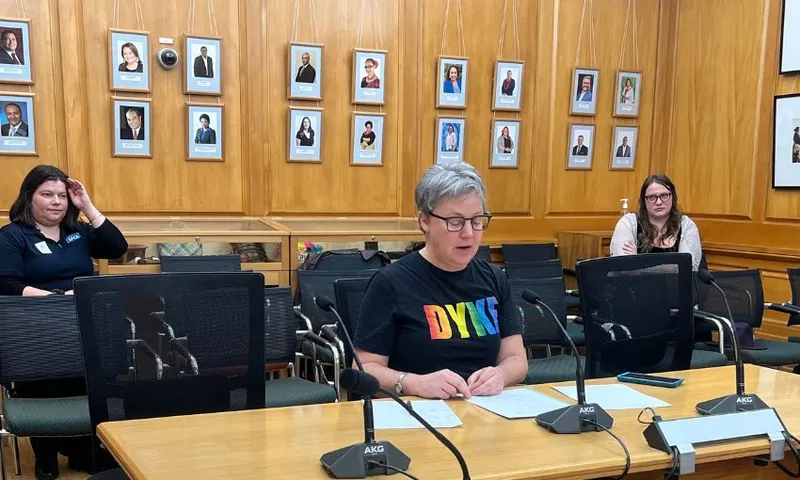
We’re past the halfway point in the finance and expenditure committee’s oral hearings into the Regulatory Standards Bill (RSB), and finally, NZ First showed up (but Act was missing in action). Committee chair and National MP Cameron Brewer had some fun, gleefully welcoming Helen Gilby and Penelope Ehrhardt of the Woke Lesbo Symposium, and telling them he had nominated them for oral submissions “purely out of intrigue”. He was sure Labour MP Duncan Webb, who couldn’t make it, would be “winding back the tapes”. What he heard was their opposition to the bill and its “fringe neo-liberal ideology” which will “redefine rights to suit the agenda of large corporations and the very rich”.
“As the Woke Lesbo Symposium, we recommend that you tell parliament to ditch this monstrosity,” Ehrhardt said, and delivered the quote of the day, describing trickle down economics as “pissing on people and telling them it’s rain.”
Earlier, the first submitters of the day were Aotearoa NZ Association of Social Workers’ kaihautū Lisa King and senior policy analyst Bronwyn Larsen, who opposed the bill on the basis that their industry is informed by “human rights, social justice, te Tiriti o Waitangi, and the dignity and worth of all people” – passing the RSB would “threaten and undermine” this, King claimed.
As an analyst, Larsen said it had been “frustrating” seeing a number of bills being passed without evidence to support their necessity, which reflects “ideology valued over evidence and lived experience”. She worried “structurally inequitable” policies such as youth boot camps and the removal of section 7aa from the Oranga Tamariki Act would continue with the passing of the bill, and the emphasis on property would potentially “erode tenant rights for low income whānau”.
“Surely we must see the devastating irony of this, given the long history of forced dispossession of iwi land and property?” Larsen said.
Suze Jones, Deputy Clerk of the House, suggested amendments to the bill – an effort the Clerk only makes once or twice a year, when a bill has the potential to impinge on parliament’s workings, or if it’s “drafted in a really unusual way”, Jones said. Principles need to be developed on a cross party basis to ensure “broad buy-in” across parliament, and Jones suggested the RSB be re-drafted in line with the tiered approach in part 4 of the Legislation Act 2019.
It was also “very strange” that the regulatory standards board would be given direct access to the select committee, she said, and more clarity was needed on the overlap of functions between the regulatory standards board and regulations review committee.
Law professor Dean Knight submitted against the bill, as it is an “instrument of politics, rather than a blueprint” to good law-making. He argued the RSB will fail to deliver on its “constitutional mission” as many of the norms embedded in it are “heavily contested and represent ideological dogma” – a more “constructive regime” would draw on principles in the legislation guidelines. Knight also worried the regulatory standards board may breach separation of powers, and that it “invests too much political power in the hands of the minister for regulation”.
Seafood New Zealand chief executive Lisa Futschek and Mark Edwards from NZ Rock Lobster Industry Council submitted together, and told the committee that while the fishing industry does need improved regulations, they had reservations that the RSB would achieve this. Futschek recommended the principles in clause 8 be replaced with “more comprehensive and broadly accepted” principles, and doubted that a regulatory standards board would be necessary – its proposed functions should rest with the regulatory review committee or Ministry of Regulation.
They called on the committee to exclude secondary legislation made under Treaty settlements (such as the Ngā Rohe Moana o Ngā Hapū o Ngāti Porou Act 2019) from the bill’s scope, for fear that “inconsistencies” could arise between the bill’s principles of responsible regulation and Crown obligations. Edwards said that while the Crown should uphold its responsibilities to the Treaty, costs that would arise from property rights will continue to be imposed on third parties.
Simon Upton, parliamentary commissioner for the environment, told the committee the bill’s focus on individual and property rights and liberties meant the consequences for public resources such as air, water and soil are “unclear”. He suggested that the bill should include a specific detail in clause 8 to “make it clear there’s no right or liberty to pollute, then we’d at least put one line in the sand”.
The SPCA’s Marie McAninch, who submitted against, spoke of how the bill could add a “barrier to animal protection that we don’t need”. McAninch gave the example of an animal welfare officer removing a neglected pet – the dog is property which is being taken, but is also a beneficiary of being taken. The bill’s principle of the taking of property asks for a beneficiary (or those acting on behalf) to compensate the person who has had their property taken – in this scenario, “arguably it is the SPCA that should be paying animal abusers”.
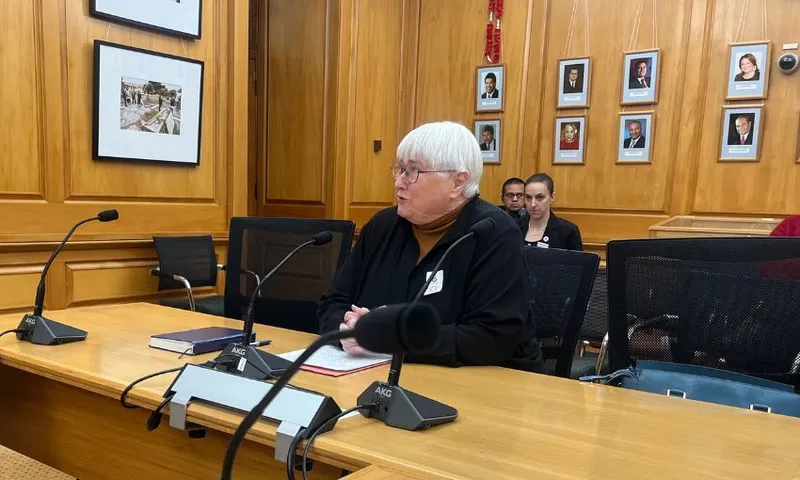
Former Labour minister Marian Hobbs also submitted against the bill, which she labelled a “lobbyist’s dream”. She remembered working on air quality standards in Christchurch as the former minister for environment in the 2000s – “up to 400 people a year died in Christchurch as a direct result of poor air quality, that’s why you need regulations … [they’ve] got an awful lot to do with community and public health”.
“I would hang my head in shame if in order to be a nice member of your coalition, you actually put your name and your votes to this piece of poor legislation,” Hobbs said.
Tom Pearce of People Against Prisons Aotearoa submitted against the bill, with the concern that it would give wealthier New Zealanders a “disproportionate ability to shape” laws through lobbying, pressure and donations – Pearce compared this to the criminal justice system, where eight times as many people are prosecuted for benefit fraud than tax fraud. Next, Auckland Action Against Poverty’s Agnes Magele also submitted against, and told the committee those she works with likely won’t see any benefit from the bill, as government policies such as benefit sanctions have made living in poverty “absolutely worse” – “it feels like we’re being punished for struggling.”
“I don’t know if that’s something that yous will understand, if you’ve never actually lived in poverty before,” Magele said.
Nuhisifa Seve-Williams from Niue Group also opposed the bill for undermining the Treaty and the possibility of “meddling” in constitutional arrangements between Aotearoa and its Pacific neighbours “made in faith by our ancestors”. She said Niueans had been “appended” to Māori since migration, and life in New Zealand had shown them that “the discourses that shape government directives and practices in respect of Māori will impact us”.
“We do not feel the trickle down effect of wealth to the poor, but we feel the trickle down effects of Māori gains and losses,” Seve-Williams said.
The finance and expenditure committee will resume oral hearings into the bill today at 8.30am.

Lyric Waiwiri-Smith
Lyric is an award-nominated politics reporter at The Spinoff. She covers parliament from the press gallery, pens the weekly column One MP, One Pint and is endlessly curious about what makes our decision-makers tick. Off the clock, Lyric loves a live gig, a cold brew, and being a Wellingtonian (on a good day).


