Ruth Richardson v Nicola Willis, and the mother of all epochal debates

Ruth Richardson and Nicola Willis in budget mode. (Images: Getty; Parliament TV. Design: Tina Tiller)
Two National finance ministers, three decades apart, are locking horns. But just how different is the political environment of today to the time of the juggernaut?
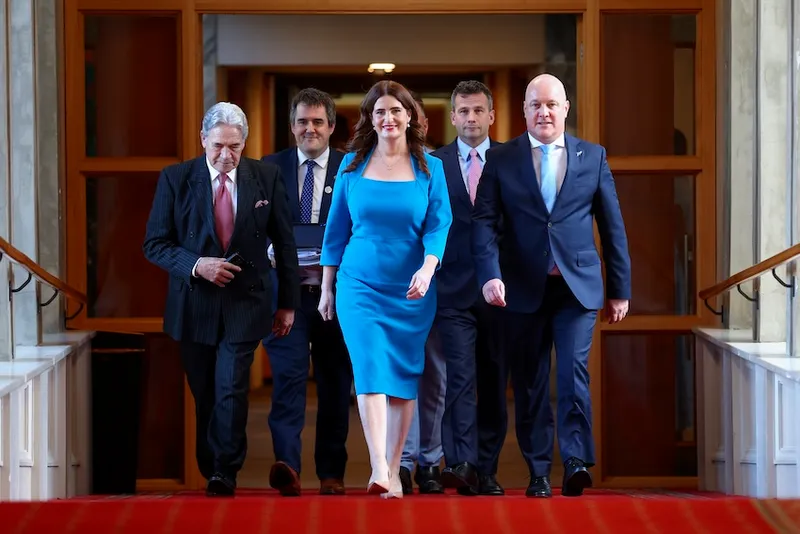
Most politicians, when they depart, sink swiftly into the footnotes. Some, however, never really go away, knocking around the house like ghosts, mythologised and caricatured, variously made saints and scoundrels. So when reports emerged of a new campaign from the Taxpayers’ Union lobby group, said to be singling out Nicola Willis for too much spending and too little cutting, they came framed up as a battle royale between the finance minister of today and the finance minister of 1990, Ruth Richardson, who these days sits in the chair at the TPU.
That comparison, which dates back at least to the last election campaign, has been greeted like fingers down the blackboard by Willis. She has questioned whether people would be so eager to juxtapose the two were it not for that rare, shared distinction: being women holding the finance portfolio. But this time, even before the TPU campaign proper was launched, she struck back, challenging Richardson yesterday to “come and debate me face to face. Come out of the shadows.”
Quickly and inevitably, that was dubbed “the mother of all debates”, and it is the 1991 “mother of all budgets” that Willis wants Richardson to address in “defend[ing] her legacy”.
Willis wants to debate, she told reporters, “the impact of what some of the things that she is calling for would be on everyday New Zealanders and their families, to test what her tolerance for human misery is”.
The TPU said last night that Richardson is up for it. We’ve invited the pair to go head to head in the most suitable of all settings, a bonus seventh episode of the Juggernaut 2.
On that podcast and elsewhere, the former minister of finance has been more than willing to stack up the early 1990s against the mid 2020s. Bleak GDP numbers released in September saw her exhort Willis to deliver a “spring statement”, with a clear nod to the austerity mini-budget unleashed in December 1990. (She stopped short of joining Roger Douglas in demanding Willis resign.) Earlier in the year, Richardson had cited her own experience in the job in challenging Willis to pursue tougher fiscal measures, saying, “when you’re the minister of finance, you’ve got to be the hard man.”
And it’s not just media or Richardson joining dots. Willis’s boss, Christopher Luxon, has himself compared the inheritance of this National government to that of Jim Bolger and Ruth Richardson. “This generation of political leadership has had to relearn the lessons of 35 years ago,” he said in late 2024, “which is, if you let government spending get out of control … then [you] drive into domestic inflation, then drive up interest rates, then put the economy into recession for the last three years.”
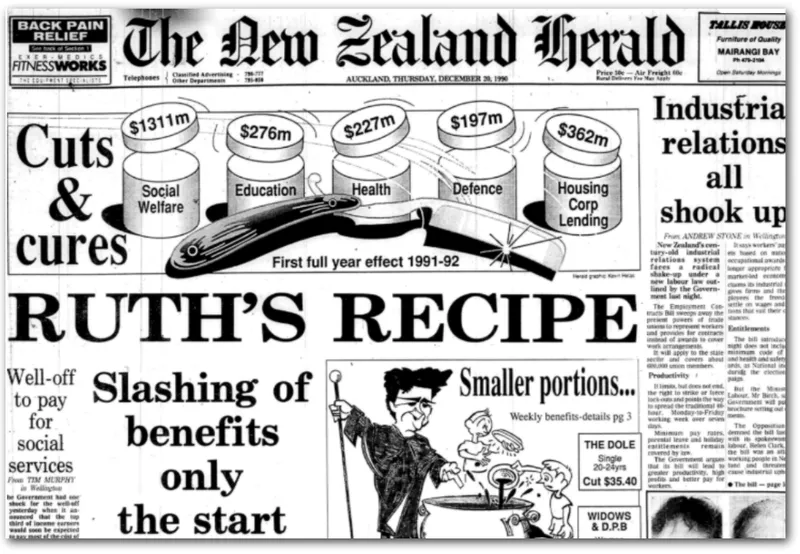
Whether the experience of that first National term in the 90s stands as an inspirational template or cautionary tale is – to put it mildly – debatable. But there is little doubt that Willis was determined to avoid repeating the scale and ferocity of the reforms spanning the December 1990 mini-budget through to the mother of all budgets of June 1991. That whiplash chapter included swingeing cuts to social welfare that saw some declaring the death of egalitarianism in New Zealand. The widespread pain that resulted is not disputed; whether it was necessary, and at that depth and pace, very much is.
Another question hangs in the air – one that Richardson among others has alighted on: in 21st century New Zealand, under MMP and in a markedly different political and media environment, is change of that kind even possible?
The juggernaut, sunk
In the weeks leading up to the 1993 election, backbench MP Bill English joined a panel conversation on Radio New Zealand. Among other things discussed was the likelihood of the electorate choosing in the imminent referendum to switch to proportional representation, in the form of the mixed member proportionate system, with a view to applying a bit of a brake on what Geoffrey Palmer had called the “unbridled power” of New Zealand cabinet-bossed governments. Such a switch, said English, casting effortlessly forward to a podcast to be released 32 years in the future, would “certainly mean less of the sort of sharp-shock change, which is something that goes quite, quite naturally with the kind of juggernaut executive government that we’ve that we’ve tended to have”.
New Zealand did vote for MMP, albeit by a tighter margin than the precursor referendum in 1992, when the first-past-the-post system was jettisoned. There was no doubt that was driven substantially by successive governments – encoded in “Rogernomics” and “Ruthanasia” – and what felt to many like elected wrecking balls, delivering changes well beyond their campaign pledges.
“It’s been difficult in New Zealand for 10 years or so, and there will be some who will be voting just to get, almost, back at the system, because the system, in their view, hasn’t been very kind to them,” said Jim Bolger in 1992. His Labour counterpart, Mike Moore, reckoned “it represents not a voice of resentment, but a scream of resentment.” One of the most successful MMP exponents, Winston Peters, would later say the vote had been delivered “to ensure moderating influences in New Zealand politics would prevail, as opposed to the extreme philosophy which permeated New Zealand politics in recent decades”.
Along with MMP, National notched a win in 1993. The party had recovered from horrific polling results following the mother of all budgets to enter the campaign in confident shape as the economy rebounded, but some of the polling proved overly sunny, prompting Jim Bolger’s indelible “bugger the pollsters” remark on election night. They had won, but by the very narrowest of margins – that second term relied, in fact, on Labour MP Peter Tapsell agreeing to take the speaker’s chair. Given the decline from a landslide victory in 1990, it wasn’t just MMP that signalled the end of something else, observed Lianne Dalziel, another young MP.
She told RNZ at the end of 1993, with a similar prescience as far as epochal change and future audio projects are concerned: “I think when the election night result became clear, my initial reaction was that the juggernaut had halted … People in my constituency felt very much that they were on the receiving end of pretty massive and very quick-moving decisions, and I think that the result of the election has given them a feeling of respite, you know, that they can now relax a little bit, that the overwhelming weight of change has been slowed right down. And I think that’s actually quite positive.”
(These weren’t the first “juggernaut” invocations in relation to the governments of the 80s and 90s. Other prominent examples include an early use of the term by Jane Kelsey, not to mention David Lange himself, who, upon his resignation in 1989, said he had “stopped the juggernaut of the new right”.)
In 2025, Dalziel, who has since served multiple terms as a cabinet minister and mayor of Christchurch, stands by that assessment. People at the time had recoiled at the blizzard of reform across the years of 1984 to 1993 under two governments – New Zealand’s version, she said, of what Naomi Klein would later dub the “shock doctrine”.
From the deregulatory sprint to cuts in benefits and labour reform, from health to education, “all of these things just flooded, one on top of the other”.
The managerial rise
The shift in the axis after the juggernaut years is something Matthew Hooton thinks and writes about a good bit. He learned about politics as a young pup in the Bolger government, having won a job in education minister Lockwood Smith’s office fresh out of school in 1991, after pestering his private secretary for months.
“I think she got sick of me and gave me what was meant to be a summer job, but turned into seven years,” he told me over the line from Mongolia, where he is teaching philosophy at the national university. “The drinking age was still 20, so I was an illegal underage drinker in the very heart of government for a month or two.”
Hooton – who wrote on the Taxpayers’ Union campaign, with reference to the Richardson legacy and the impacts of MMP, in his NZ Herald column on Friday – is very much of a mind that the mode of political change is transformed. For all its imperfections, Hooton believes, first past the post empowered governments to take big swings to deal with what they considered big problems. Today, it’s all about playing for an amorphous blob in the middle, the “median voter”.

What the system had gained in terms of representation in parliament it had lost in terms of “a narrowing of interests to the main parties’ focus when they’re trying to win votes. That has been, in my view, to the detriment of the system.” A battle of ideology had been whittled down to bribing that group in the middle, with the major parties “basing their entire election campaigns on waving a $20 note around the streets of the median voter”.
Ruth Richardson feels similarly. Speaking to the Spinoff for Juggernaut 2, she called MMP “a very big own goal”. In an effort to remedy an insufficiently representative parliament, New Zealand had over-corrected. “The trouble is we now have too much representation and not enough government,” she said. “In other words, governments can’t govern … It’s destroyed the quality of decision making.”
The constant need to compromise had diminished difficult but necessary reform, she argued. “Why have we got a structural deficit? Because the minister of finance doesn’t feel that she has got, even if she wanted to [implement bold reforms], the numbers to be able to see it through … We’re saddled with a system that compromises our ability to take good decisions until a crisis will make us take those decisions. And that’s not what I wish for New Zealand.”
Richardson, of course, was gone from parliament by the time MMP arrived. She would go on to champion the fledgling Act Party alongside Roger Douglas and Richard Prebble. Looked at in those terms, a Richardson-Willis debate can be seen as an Act versus National contest as much as anything.
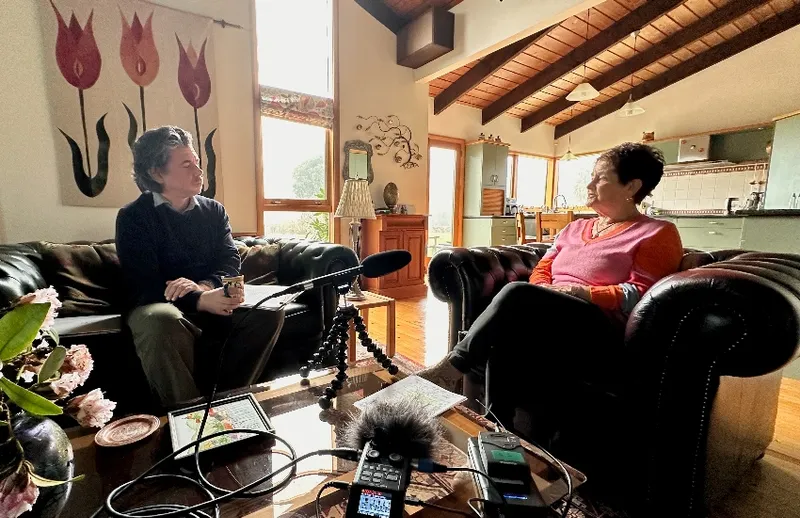
In Hooton’s view, MMP had encouraged politicians to “prattle on about so-called bipartisan approaches, which never work”. He said: “I can’t think of a single grand bipartisan announcement in advance of a policy which has ever lasted more than a few years, the way you used to get bold change from the left or the right, whether it’s Savage and Nash and Fraser setting up the welfare state or Roger Douglas and Ruth Richardson and Jim Bolger, it’s through leadership. You announce your nuclear-free policy, you float the dollar, you make unionism voluntary. You cut benefits, you raise benefits, you introduce a new tax, GST or a capital gains tax.
“And you do that against your political opponents, often against the will of the majority and certainly of the median voter. And then you show it works, and that’s what locks in a policy reform. But the ability to do that now is almost gone, and as a result, people who might go into politics with the hope of being able to do something bold, whether left or right, they don’t even go in now. And you get these managerial people who think that the best way is to just leave things roughly as they are, and, apparently, keep the public along with you and form ‘consensus’ before you do anything.”
Is there not a danger of romanticising those days of “sharp-shock change”, to borrow English’s phrase? Wasn’t it precisely the more cautious, modulated approach to government that people were voting for?
Hooton accepts some of that. The modus operandi of Roger Douglas and Ruth Richardson was instrumental in the advent of MMP, he said. “They, along with Muldoon and the results of the 1978 and 81 elections and Think Big and some of the questionable constitutional things, did cause MMP, and that does have to be part of the legacy of the economic reforms – that they went too far, too fast, hurt too many people. But New Zealand has been in a holding pattern since around the middle of the first decade of the century … We adopted an electoral system that had been designed by the Americans to impose upon Germany to stop them becoming Nazis again. It was designed to stop Germany from ever being able to do anything again. And it’s been very successful in that respect, and sadly it’s been very successful in terms of New Zealand in leading to a similar extreme form of stability and public policy.”
And by his estimation, every MMP government has been worse than the one before. “I mean, we should have a wealth tax or a capital gains tax by now, we have had Labour governments who support wealth tax or capital gains taxes. We have a serious revenue problem, which means that we’re going broke.”
Another thing that has changed, Hooton suggested, is the way policy is made – these days more by message makers, by focus groups. “There’s no way that things like the benefit cuts, the Employment Contracts Bill, the education health reforms, the treaty settlement process, there’s no way these were designed by PR people,” he said. “They were designed by policy makers led by the prime minister and his senior ministers in the Bolger era and the PR people were told this is the policy. Now you find a way to sell it. And that probably sounds old fashioned now, because the practice in successive governments, and it just gets worse and worse, is to do a focus group and some polling and come up with a slogan like Fix New Zealand, or, you know, Get New Zealand Back on Track, or A Kinder, Gentler Country, or whatever it might be, and then design policy around that.”
Dead or just resting?
While 1993 might have seen the juggernaut halted, it was not, in Lianne Dalziel’s view, buried. She is one of 10 former MPs, including Marilyn Waring and Nanaia Mahuta, who has launched the People’s Select Committee on Pay Equity, in an attempt to provide the mechanism that summary repeal, expedited under urgency, was denied. (It is the pay equity reform that prompted Andrea Vance’s controversial “girl math” column, which lined up Willis alongside Richardson.) “Having listened to the submissions that weren’t listened to by the government,” Dalziel said, her view was the coalition government had “done a juggernaut on that decision”.
As for the impacts of MMP – and Dalziel said she thought social media had changed the nature of politics at least as much – the former Labour minister suggested that in reality it made single-term governments more likely. Or, to put it another way, that the accepted wisdom that one-term governments are hen’s teeth in New Zealand politics is overstated, amplified by the first-past-the-post mathematics. Here she pointed to 1993, the last first-past-the-post election, in which history records that National hung on, albeit by a thread. And yet Labour and the Alliance had won 53% of the vote between them, a comfortable win under MMP for the left.
All of that might figure somewhere in the thinking of Nicola Willis, as her own stewardship of the economy comes under the spotlight again. Perhaps, she might think, it’s not the worst thing in the world to be publicly admonished for failing to be the “hard man”, in Ruth Richardson’s coinage.
After all, despite scraping through in that “bugger the pollsters” election of 1993, one of Bolger’s first decisions was to replace Ruth Richardson as finance minister. She refused to accept any other role – “they were genuinely surprised that I would turn down … a continuing political career on account of principle,” she told us for Juggernaut; “they obviously didn’t know me well enough” – and shortly afterwards quit politics altogether.
Or parliamentary politics, at least. Wherever you might sit on the Richardson v Willis war of words, one thing Richardson can’t be accused of is retreating to the shadows.

Toby Manhire
Toby Manhire is editor-at-large at The Spinoff. He loves to cast a pod, whether it's Gone By Lunchtime, At Large or Juggernaut. He is a former editor of The Spinoff and has worked as a journalist in NZ and the UK since the last millennium.


