The government’s consistent, principled approach to economic data

Image: The Spinoff
If it’s good, the government did it. If it’s bad, it’s someone else’s fault.
When data came out showing inflation at a 12-month high on Monday morning, the government quickly started channelling the enduringly popular and intergenerationally relevant reggae fusion artist Shaggy. “It wasn’t me,” said prime minister Christopher Luxon, in an interview with Newstalk ZB’s Mike Hosking. “All I can do is the bit that I can do, which is the fiscal side of things. The Reserve Bank controls the monetary policy,” he said. “It wasn’t me,” said finance minister Nicola Willis, in a press release noting inflation remains within the 1 to 3% target band. “The effect of council rates on inflation is a concern,” she said. “That’s why this government has also been clear in its call to councils to focus on the basics and keep rates under control.”
Both politicians have a point. Inflation is at the mercy of an array of local and international factors. The economy could be humming along, only for one of Donald Trump’s brain worms to writhe the wrong way and prompt him to bomb the Middle East or raise tariffs to 150% on Gondwanaland. International dairy prices could spiral, sending the price of 400g of Westgold to roughly the equivalent of 400g of actual gold. Local councils might suddenly realise they’ve forgotten to properly maintain or upgrade their pipes for 50 straight years, forcing them to raise rates to stop town centres being drowned beneath spontaneously formed lakes of raw sewage.
All these events are, to varying degrees, outside the control of the current government. Inflation is to a large extent the result of decisions the Reserve Bank made a year ago while weighing up an array of factors. But if Luxon and Willis aren’t responsible for inflation, several of their past statements seem perplexing, starting with all the times they’ve directly taken credit for inflation.
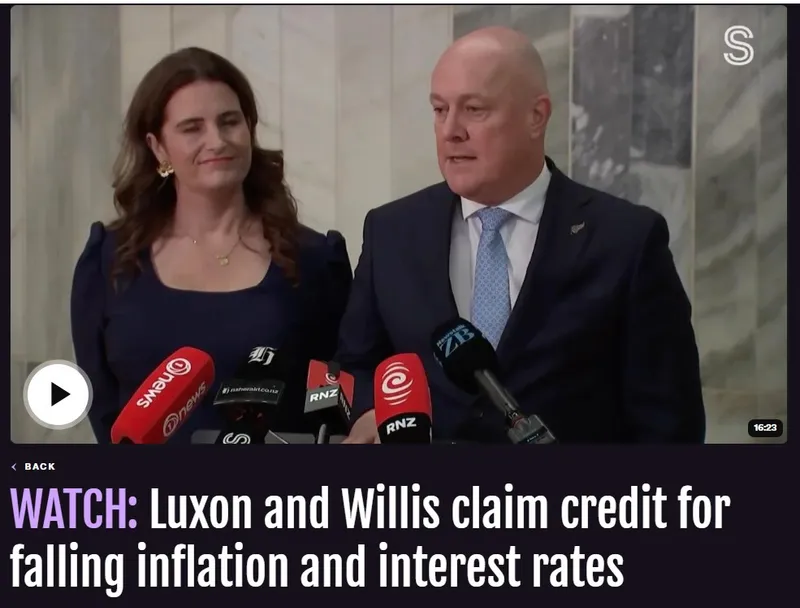
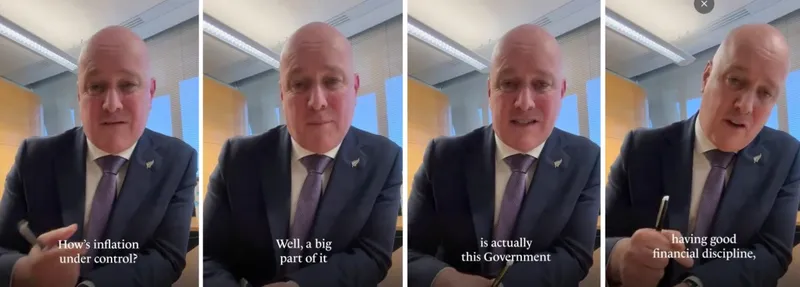
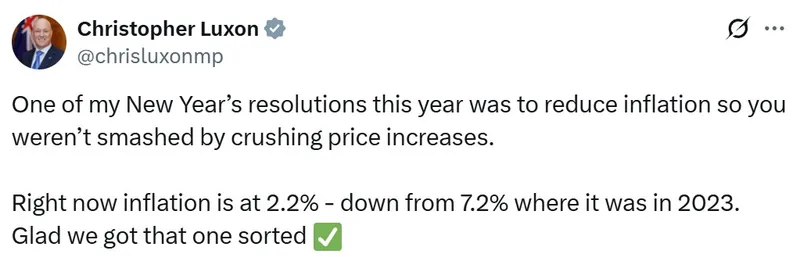
Similarly, Luxon has regularly taken credit for the Reserve Bank’s decisions to cut the official cash rate, which are interlinked with inflation and similarly subject to the international economy.
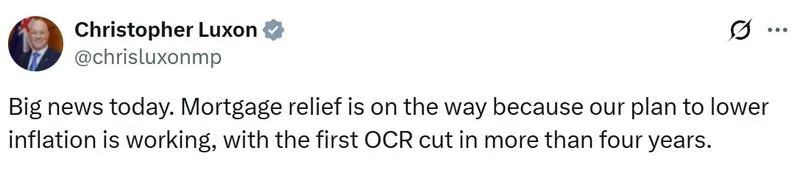
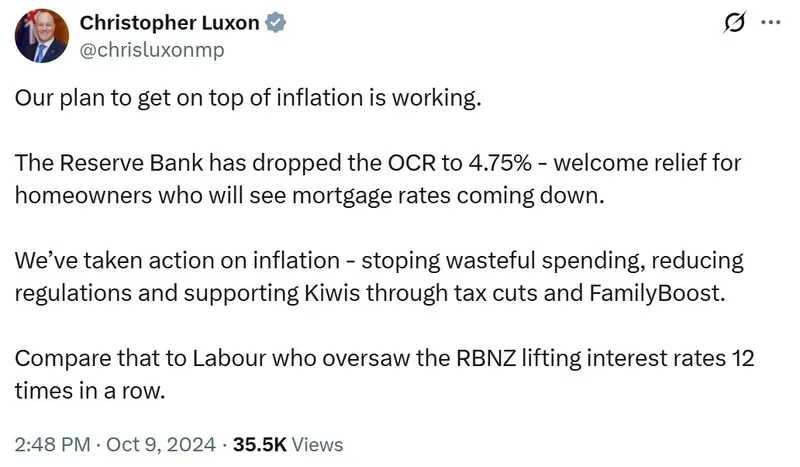
Some would see double, or at least inconsistent, standards in these statements. On the face of it, that’s fair. But on a deeper level, they’re in line with a consistent and principled approach from the government when it comes to interpreting economic data. It’s routinely applied the same standard, whether it’s to a wellbeing indicator or a GDP update. The method boils down to a single precept: if it’s good, then the government did it, and if it’s bad, it’s someone else’s fault.
Take young people moving to Australia. Prime minister Chris Luxon has shrugged off the government’s potential role in the return of the brain drain. Though some could point to the cancellation of dozens of public infrastructure projects and the subsequent slowdown in the construction sector as a factor in rising migration across the Tasman, he has eschewed that for other explanations, telling Ryan Bridge that stemming the outward tide comes down to delivering better education, more efficient access to healthcare, and improved public safety.
In 2023, Luxon’s deputy David Seymour said “Kiwis [were] voting with their feet” when roughly 24,000 New Zealanders left for Australia. When 30,000 people departed last year, he blamed the economic wreckage left by Labour, telling reporters it was down to a “hangover from Covid”.
When GDP goes up, it’s the government’s plan working. When it goes down, it’s six years of economic vandalism under the last one. When food prices rise under Labour, it’s Labour’s cost of living crisis. When they rise under National, it’s still Labour’s lingering cost of living crisis.
If something goes wrong, like the government failing to fund 13 new cancer drugs it promised to sick patients during the election campaign, it’s Labour’s fault. If something goes right, like 7,000 new state houses getting built, it’s thanks to National even when they were funded by Labour.
It’s a bipartisan trend. For several long years after it was elected in 2017, Labour screamed the words “nine long years” in response to any criticism from National. It’s been critical over the latest inflation data, pinning the blame entirely on the government’s economic management. When inflation went up while it was in power, it was a victim of the global inflation pandemic.
Some of their criticisms have merit. Some of their self-aggrandisement is fair. But the overarching message from our politicians is that if something makes you sad, then it’s the other guy’s fault, and if something makes you happy, it’s theirs. Maybe a more honest, responsible approach would be to admit that some things are beyond the control of politicians on a small island at the bottom of the south Pacific; that the weird conniptions of great and terrible global powers could make and break our economy at any moment; that the cost of living in New Zealand is far more reliant on the whims of Chinese parents than bike lane-loving councils; that we have only a small amount of control over our own affairs and chaos beckons at every corner.
You may think that’s impossible. ‘You may think it’s a ridiculous hope, borne of political naivety. But if you do, then I have a response you’ll have to accept: this is all my editor’s fault.

Hayden Donnell
Hayden Donnell is a senior writer for The Spinoff. He previously worked at RNZ, TVNZ and the New Zealand Herald, alongside other media companies that have since closed down or been renamed. His primary passions are local politics and the Big Fresh animatronic fruit and veggies.


