


The former PM retired three years ago. The very mention of her name still has the power to send grown men spiralling into a spittle-flecked rage.
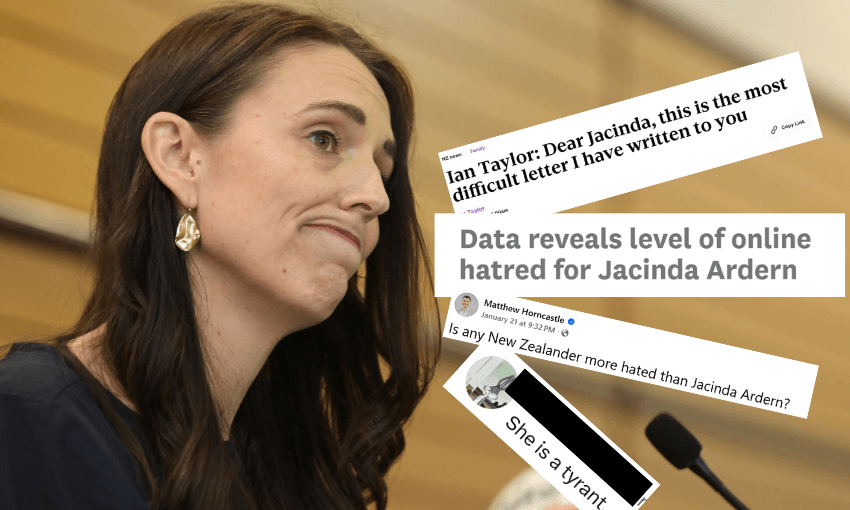
When The Post’s deputy political editor Henry Cooke shared a Freshwater Strategy poll result to X recently showing Jacinda Ardern is still the country’s most popular politician, the response was swift and deranged. Hundreds of replies washed in, most from pseudonymous accounts who were absolutely ropeable. “She’s not welcome in this country,” said Auckland Gooner. “We love to hate the tyrant bitch,” said Random Itinerary. “She is communist vermin,” said The Chasing Ghosts Podcast. Another account simply posted a picture of a shopfront statue shitting.
Well that’s X, the everything app, you might say. It’s true the site has been prioritising the incisive brand of commentary produced by accounts like Auckland Gooner since being bought by the world’s wealthiest white nationalist in 2022. But Cooke says it’s been this way for longer than four years. “Jacinda Ardern is a once-in-a-generation political figure for engaging people online. Positively and negatively – but on Twitter these days, especially negatively,” he says.
There’s data to back that up. A 2023 Auckland University study found Ardern received online abuse at a rate 50 to 90 times higher than any other high-profile public figure. The vitriol directed at her was also more insistent and obsessive than for any other public figure, firehosing out of the internet at a consistent rate for the yearslong duration of the study. “While for the other politicians and bureaucrats such posting generally peaks in response to events and then drops, posting targeting the prime minister was constant, incessant,” said study author Chris Wilson.
But why? Or to put it more precisely, why still? Ardern retired from politics three years ago. She moved to the US shortly after and has said little about New Zealand politics since. While she hasn’t faded from the spotlight thanks to her penchant for writing books and appearing in movies, it’s still startling to see 536 of the country’s most off-putting middle-aged men materialising to slam their heads repeatedly into their keyboards at the mention of her name.
The obsession isn’t confined to X. Sir Ian Taylor has put his legacy as a pioneer of cricket’s ball tracking tech at hazard after developing an addiction to writing open letters to Ardern, several of which have been published by reputable news organisations. When he’s not talking up his company’s townhouses, Williams Corporation managing director Matthew Horncastle appears to spend most of his time relitigating Ardern’s political legacy in a compendium of Facebook posts all titled “Jacinda Ardern: a national mistake that must never be repeated”.

Conversely, there’s that poll result. It’s kind of weird that Ardern is still our most popular politician given she’s a) no longer a politician and b) not even doing political stuff. When her memoir, A Different Kind of Power, came out last year, it strained our libraries’ waitlist systems. The documentary about her time in office, Prime Minister, was one of the highest-grossing movies ever at the NZ International Film Festival and made more than $1m at the box office.

Psychotherapist Paul Wilson lists a number of potential reasons for Ardern’s lingering hold on our national psyche. The first is common to every politician. “When someone is elected to public office, they cease to be a person and become a parasocial symbolic figure,” he says.
That’s less philosophy than basic biology. It’s hard-wired into our mammalian hind brains to be more sympathetic to people we encounter in person. Becoming a subject of The Discourse removes that biological brake. “The politician becomes a flat icon onto which we project our internal states,” Wilson says. “We aren’t engaging with a human being but with a symbol.”
Green Party co-leader Chlöe Swarbrick remembers her own transformation from nuanced human being to talking point. She’d just been sworn into parliament when she went to protest an arms expo in Wellington. “And of course, Mike Hosking was just going off that day, and my dad called me really, really upset,” she says. “I was just like ‘dad, you might not want to listen to Mike Hosking anymore because it’s going to be like this the whole time that I’m in politics’.”

Swarbrick has had lots of run-ins with people more extreme than Newstalk ZB’s morning host since then, but she still finds the dehumanisation off-putting. “There is this really bizarre thing where there’s the individual self, and then there’s the concept of you, which has some extrapolation of those individual things, but then the concept kind of takes a life of its own.”
Though Swarbrick has seen her share of parasocial weirdness, she acknowledges Ardern’s experience is on a whole other level. In his 2023 study, Chris Wilson posited the former PM had become a “lightning rod for a range of fears, misogyny and anger throughout the pandemic”.
Paul Wilson adds that the intensity and intractability of Ardern’s predicament is a product of her unique circumstances. Thanks to the cascade of national disasters and tragedies throughout her tenure, she took actions that some men experienced as an emasculating loss of autonomy.
That started with the government’s gun buyback following the March 2019 Christchurch terror attack and kicked into overdrive with the pandemic. Covid-19 created a strange alliance between the authoritarian right and the wellness left, both of whom felt othered by the government’s response, and that sense of alienation reached its zenith when Ardern announced vaccine mandates, Wilson says. “They could not reconcile the leader who said ‘they are us’ to the Muslim community with the prime minister who effectively said ‘no jab, no job’ to them.”
He sees the continuing angst directed at Ardern as a defence mechanism; a necessity to preserve “psychic stability”. “The shame of being othered was traumatic. To manage it, they split the world into absolute good, the resistance, and absolute evil, ‘Jabcinda’.” On the other side of the coin, the people who appreciated Labour’s life-saving Covid response still feel a debt of gratitude to the person at its helm and a connection to the “mother of the nation” who led them empathetically through a traumatic episode. “Beyond the unconscious archetypal projections, there are real, substantive reasons for that lingering attachment,” Wilson says.
Ask politicians from the right, and they’ll recite a list of political reasons for the continuing dissatisfaction with Ardern. National has repeatedly criticised Labour for running up debt during Covid. “We got an inheritance that was the biggest recession in 35 years, we’ve got the longest hangover from Covid of any Western economy,” Chris Luxon told reporters in September.
That doesn’t seem like a good enough reason to someone like Swarbrick, who sees Ardern’s government as disappointingly middle-of-the-road in some respects. If you take away the nation-shaking disasters, her tenure in office was relatively muted. No major expansion of the welfare state, no enduring changes to the balance of power between workers and bosses and most certainly no capital gains tax. So why the continuing mania? “I think honestly, part of it’s timing with Covid and the wheels clearly falling off of the neoliberal economy,” Swarbrick says.

Swarbrick pulls out a photo of her and Ardern at the Grey Lynn festival in 2016. It’s strange to think of the future PM as she was back then. Before she was Jabcinda, the woman who locked us up, or the woman who rescued the country and pioneered a new kind of leadership, Ardern was a promising, if not flourishing, politician. She’d twice tried and failed to win the Auckland Central electorate off Nikki Kaye and was hanging around the edges of Labour’s front bench.
Now that same woman needs a bodyguard with her to go get a coffee. She exists at the extremes of experience. But Swarbrick remembers someone decidedly normal in that photo, grinning and wearing an oversized rosette on the Grey Lynn Park grass. Ardern was earnest, conscientious, and yes, kind. Not an angel, not a devil, not yet a symbol; just a person. Maybe some day she’ll be able to be one again.