A deed of acknowledgment has been signed – so what’s next for the Waitākere Ranges?

Design: The Spinoff.
A deed of acknowledgment has been signed empowering mana whenua to contribute to how the significant heritage area is managed.
Wherever you are in Tāmaki Makaurau, you can almost always see at least one of the two main mountain ranges at the edge of the city. To the south lie the Hūnua Ranges and out west, the Waitākere Ranges provide a damp, thick and rugged forest buffer between metropolitan Auckland and the Tasman Sea.
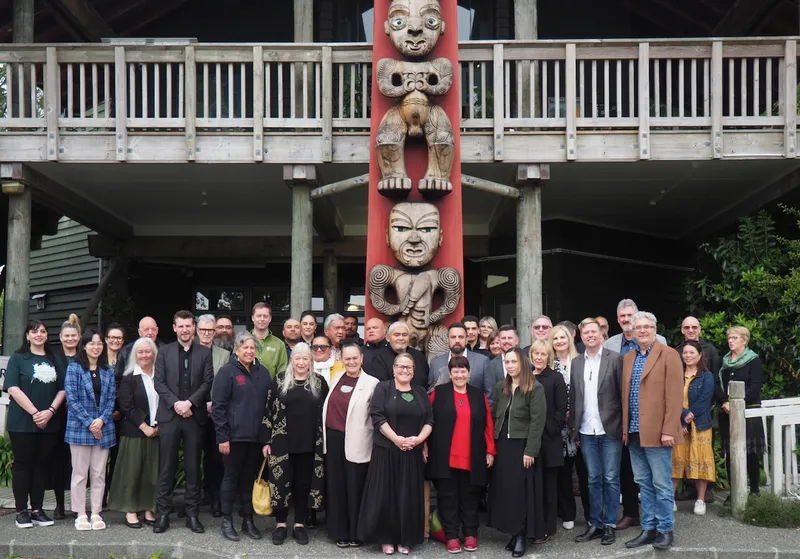
At the beginning of this month, representatives from Te Kawerau ā Maki, Auckland Council and the Crown gathered at the Arataki Visitor Centre in Waitākere to sign a deed of acknowledgement regarding the Waitākere Ranges Heritage Area.
Spanning more than 27,000 hectares of forest, coastline and small communities in West Auckland – including the 17,000-hectare Waitākere Ranges Regional Park – the Waitākere Ranges Heritage Area is one of the most biologically and culturally significant landscapes in the country. It’s home to dense native ecosystems, ancient walking tracks, and a living connection between tangata whenua and their ancestral lands.
The Waitākere Ranges Heritage Area Act became law in 2008 and was introduced to protect the area’s “heritage features”, including its diverse ecosystems, landscapes, cultural sites, and the longstanding relationships tangata whenua have with the whenua. More than 17 years later, the deed of acknowledgment has been implemented to give practical effect to the rights of tangata whenua recognised under the legislation.
When asked in an interview why he thought the deed had taken so long to be drafted, Te Kawerau ā Maki Tiaki Trust chief executive and environment manager Edward Ashby said it was “a good question and one perhaps better asked to the Crown and council”. He said the burden for such legislative triggers to be pulled often fell on iwi and said he had been advocating for the creation of the deed since 2013. “[There] has been a wall of indifference to actually dealing with this part of the act,” Ashby said.
As a result of the deed, a joint committee is being established for the purpose of providing advice and recommendations for the strategic plan and management of public land within the area. In addition to the strategic plan, the joint committee will also develop work programmes to achieve the strategic plan outcomes and joint monitoring of both the strategic outcomes and the Heritage Area itself.
Named the Waitākere Ranges Heritage Area Forum, the proposed membership for the committee includes 11 representatives: three from local boards, two from the governing body, one from the Department of Conservation and five from Te Kawerau ā Maki. However, ultimate decision-making powers and the ability to allocate resources to implementing any strategy remains with the council and Department of Conservation.
Ashby said some of the issues the iwi was hoping to address through the strategy included exploring what “good” recreation and transport options look like and progressing the area towards achieving dark sky park status. “This is one of a number of matters in the Act that need to be protected or enhanced, but no one does anything about it. It’s sort of abandoned legislation,” Ashby said.
One of the most publicised issues impacting the Waitākere Ranges currently is kauri dieback. First discovered in the Waitākere Ranges in 2006, the disease has decimated the remaining population of kauri in the forest. While a rāhui was implemented in 2018, closing all walking tracks in the area, Ashby said more needed to be done to prevent bad outcomes for the environment and the people. One example of where he saw room for improvement was the drafting of multiple recreation plans for the regional park, local park and the conservation areas.
While Te Kawerau ā Maki is happy to finally see progress with the deed, there has been push back from the likes of New Zealand First MP Shane Jones and deputy prime minister David Seymour, who both effectively labelled the proposal co-governance by stealth and expressed their disdain for the establishment of a committee containing “unelected decision-makers closing tracks and dictating land use in the surrounding rural areas”. Jones even threatened to step in to ensure the deed did not morph into a “means of co-governance”.
Originally, the committee was designed to have equal 50/50 representation; half from Te Kawerau ā Maki and half from the other organisations. However, over 2,250 submissions were made to council on the proposed deed, with 51% in favour and 39% against. Groups like Walk, Tramp, Run led efforts against the proposed deed, expressing their concerns about the committee arrangements and ongoing track closures. In response, an extra representative was added for the proposed committee, swinging the balance of power away from Te Kawerau ā Maki. There will now be three seats for the Waitākere Local Board, two for the council governing body and one for the Department of Conservation.
The next steps will be establishing the joint committee, or forum, and beginning work on the development of the strategic plan, work programme and joint monitoring programme. While the final decision-making power lies with the council and Department of Conservation, there will undeniably be an expectation they will implement the joint strategies to the best of their ability. Whether or not that happens remains to be seen.

Liam Rātana
Liam Rātana (Ngāti Wairupe/Ngāti Kurī) is editor of The Spinoff's Ātea section. He is passionate about indigenous and minority issues. Liam enjoys cooking, poetry, photography, and exploring the outdoors.


