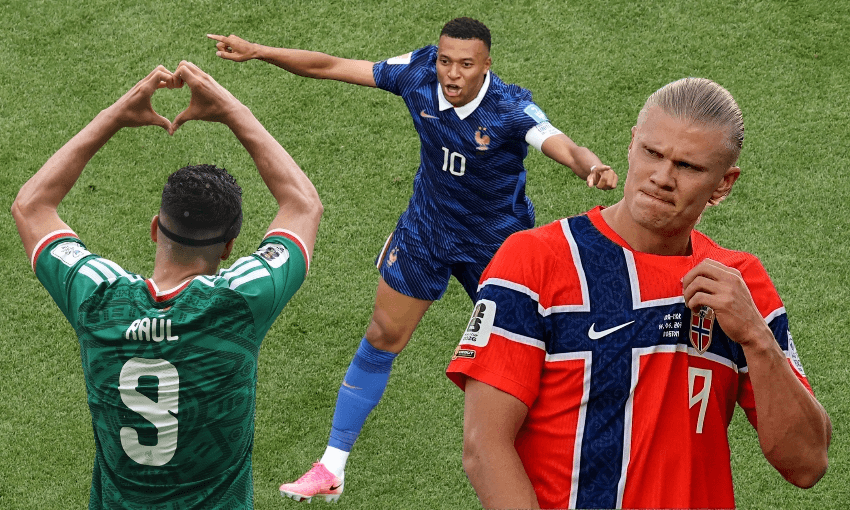



Outside of the Olympics, there are few sporting events where a nation can express their identity on a global stage quite like the Fifa World Cup. These are the football fits have caught our attention.
Football kits are high stakes. They have to withstand the physical exertion of the field, make each country and their respective outfitter look aesthetically proficient, and sell units of merch to zealous fans.
This year there are three distinct stylistic paths. Countries like Germany and Croatia have looked to the past, referencing historic kits and the crowd-pleasing nostalgia that comes with them (though no one’s yet been brave enough to produce baggy tucked-in jerseys). Others have taken an experimental approach – see South Korea’s flowers or Nigeria’s green flames. Some courageous nations have ignored both routes, opting instead for uniforms that are downright boring, leaving you to wonder if their energy has been invested elsewhere and whether it will pay off.
Unsurprisingly, World Cup uniforms are dominated by the big players: Nike, Puma, Adidas (leaning heavily, perhaps too heavily, on the easy wins of those iconic stripes and trefoil). But smaller brands also have a presence on the pitch, with Kappa outfitting Tunisia, Capelli dressing Cape Verde and Umbro adorning the Democratic Republic of Congo.
Each team has multiple looks. There are home and away kits, pre-game looks and special uniforms for the goalkeepers. What’s worn for each match depends on who is assigned the “home” team and whether they decide to wear their home gear or mix it up. “Away” teams have to look discernibly different to avoid on-field (and at home) confusion – and a team’s away kits are usually a little more flamboyant than their home versions.
With more teams and more matches than ever before, their kits present another field for competition; you could lose all your games but still have a winning look! Here are the best, the worst and the most interesting.
The good
Argentina (away)
Fabulously ornate (inspired by the fileteado decorative style) and a nice departure from the staid, though stylish, blue and white stripes of the home kit. Wonder if Peter Thiel bought one?

Belgium (away)
Behold, a case study in the theory that the hardest blokes wear pink shirts. I swear I had this as a screensaver in 1999, but the actual reference goes back further, to Belgian surrealist artist René Magritte. The width of the collar and sleeve trim is generous (designers, take note) but as good as this is, we might not get to see it, at least not in the group stages, if reports are anything to go by.

Brazil (goalkeeper)
Goalkeepers’ jerseys are traditionally where we see the most creative flair on the pitch, and Brazil’s has taken a particularly psychedelic approach. This swirling print is something you’d expect to see on a rare tree frog – or perhaps the trip it takes you on.

Croatia (home)
Points for consistency. The Adriatic nation has been deeply committed to wearing šahovnica, their name for the distinctive red and white chequerboard print, since it joined Fifa in 1994. And so it should be. Not only is it deeply symbolic – representing national identity and dating back over 1,000 years – the check looks striking on the pitch. Here’s a history lesson: this year’s iteration is inspired by a 1990 match, not long before Croatia seceded from Yugoslavia, played against the US in Zagreb; Croatia wore chequerboard jerseys for the first time and they won 2-1. War broke out the following year.

Curaçao (away)
This jersey taps into the nostalgia for old football jerseys – a winning move and one Adidas knows well. It’s inspired by Willemstad, the capital of the island nation, famous for its colourful colonial buildings (the king of the Netherlands is still Curaçao’s head of state).

Czechia (away)
A deep cut (pun intended) reference to Czech crystal, this away kit by Puma brings a rare example of fragile luxury goods to the football field, usually an arena for more robust traits. Printed inside is another patriotic touch, “hrdě za Česko” or “proudly for Czechia”, and I imagine the players are feeling that – this is the side’s first World Cup in 20 years.

Democratic Republic of Congo (home)
The motif’s meant to be inspired by leopards but all I’m seeing is some stunning labia. A bold choice! It’s worth making a splash; this is their first World Cup since 1974.

France (home)
A collar? And button? In 2026? It’s a miracle. The tricolour flourish on the sleeve and red placket are nice touches, plus that emblem looks expensive. Good job, Nike.

Germany (home)
This is good. But is it as good as the 1990 West Germany kit, designed by Ina Franzmann, which it’s clearly referencing? Or this theory? Or this year’s pre-match kit? Please debate.

Ghana (home)
There’s something so light and joyous about this. While simple in structure, the design on this jersey is what really sings. Designed by Puma, it references the folklore behind kente cloth, a traditional Ghanaian textile. Kwaku Ananse, the spider from the legend, translates to the web-like motif on the jersey, while the colours reference the vibrant hues of the national flag and the cloth. Top marks for a creative way to reference cultural history. Puma has been outfitting Ghana’s team for two decades. The away kits – also good – are inspired by the bright and busy Makola Market in the capital Accra.

Haiti (home)
This jersey was banned on the eve of the World Cup, following a friendly match with New Zealand, after Fifa ruled it breached the rules around political imagery. Haiti maintains the football body misinterpreted the imagery, which it says references the 1803 revolution and symbolises freedom. Team outfitter Saeta has created new jerseys for the tournament (but is still selling the originals).

Mexico (home)
One of the best kits in this World Cup and a nostalgic nod to the co-hosts’ legendary 1998 jerseys, this has even earned fans of the avian variety – namely, a Mexico City duck called Merlin. The pattern is a reference to Piedra del Sol, the Aztec Sun Stone, located at the National Anthropology Museum, which hosted a visit from the team ahead of the Cup.

Morocco (home)
Sublime use of pattern on the neckband and sleeve cuffs. I’m also partial to anyone who bothers to add a button in 2026 (see also: France).

Netherlands (away)
Amid a sea of retro kits inspired by the 1970s, 1980s and 1990s, the Dutch uniforms stand out for a more recent reference point. While the searingly bright home kits have people adjusting their televisions, the speedy gradient and noughties design of the away jersey gives it all the momentum of nationally embraced cycle lanes or a Ministry of Sound compilation CD from 2001.

Nigeria (away)
A case study in why everything looks better with a flame decal. The choice of vibrant greens was a smart one. Red would be too obvious and blue too cliched, but green, green is the colour of growth.

Norway (home)
The best ideas are sometimes the simplest, as we see here with the Norwegian kit which, at first glance, looks like a common tourist T-shirt (in a good way). It’s actually a reference to the 1997 uniforms and adorned with Nordic motifs. Graphic, striking, cool.

Panama (home)
This sits on the right side of retro thanks to the polo collar, V-neck and trim on the sleeves (and Reebok’s nostalgic logo).

Paraguay (home)
Simple, effective and novel, Puma has done a good job of reinterpreting the classic stripes for 2026 (less good is the durability, with the brand’s shirts reportedly prone to ripping, eek).

Portugal (away)
I see Studio Ghibli while others are reminded of MGMT, both reference points that hark back to a simpler time. The actual reference is even older: Portugal’s seafaring history, part of a very different kind of global competition than we’re seeing play out in North America this month.

Saudi Arabia (home)
Very snazzy. Excellent use of pattern and colour theory by Adidas.

South Korea (away)
Florals shouldn’t be radical for a football kit but here we are. The mugunghwa, the national flower of South Korea, represents resilience, but Nike says it was inspired by the “concentrated energy and explosive momentum” of the flower in bloom. The purple colour has proved a curveball for fans (it’s also a football rarity) but there’s a reason behind the choice: it reportedly helps players with colour vision deficiencies. Visibility wasn’t completely baked into the original design however, with South Korea being forced to change the colour of their jersey fonts from mint green to black to align with Fifa standards.

The bad
Australia (away)
This looks like something excavated from the back of my fridge.

Bosnia and Herzegovina (home)
I love this country but not this kit (sorry!), which looks like it should be helping you at Ikea.

Ecuador (home)
To Minionesque for my tastes.

England (home)
Boring and unoriginal. These shirts are a reheat of Umbro’s 2000 jerseys – Nike saucily called them “familiar” – which is perhaps unsurprising given England’s nostalgic social climate.

Iran (home)
Too plain, but with so much potential. If you’re going to use a cheetah motif (this is the endangered Asiatic variety) then you might as well go all in. However, it’s worth noting that Iran has had some other things to deal with this year. It’s a humble kit for a team that’s lacked the experiences afforded to other nations; assigned to a home base in Mexico, one of the three host nations alongside the US and Canada, they have to return immediately after each match, prompting a complaint to Fifa.

Scotland (home)
Respect to Scotland, who are playing at their first World Cup since 1998 and whose fans have been charming the city of Boston with their affable drunken antics, but these look like an emblem was slapped on a bog-standard Adidas template.

Sweden (home)
Oh look, more Ikea workers. At least that’s patriotic.

Switzerland (home)
OK, not Ikea – more like The Warehouse.

Qatar (home)
Far too plain. Far too Adidas.

USA (home)
All I’m getting from this undulating flag stripe is Where’s Wally (or, if you’re North American, Waldo, a name that is spiritually wrong) and Streets ice cream.

Uruguay (home)
I guess this would be fine for PE class.

The… interesting
Algeria (home)
Really nice collar.

Canada (away)
Jizztastic.

Egypt (home)
Points for iconography. It’s almost enough to inspire conspiratorial thinking, or dusting off the old Magic Eye books.

Jordan (home)
Trypophobics hate her.

Bonus round: The pre-game jerseys
Cape Verde
Why this was chosen for their pre-match jersey and not the main event is a mystery. This fever dream was designed by Capelli and features an animal that you’ll likely never see on a football pitch. The tubarão azul, or blue shark, is on the side’s shield too. Both Capelli and Cape Verde are making their World Cup debuts this year, and they’re off to a cracker of a start thanks to draws with heavyweights Spain and Uruguay in their first two matches.

Iraq
Gorgeous. These are made by German brand Jako and inspired by ancient Mesopotamian decorative traditions and the Ishtar Gate, built in 569BC and now housed – not without controversy or, in the case of the team’s uniform brand, irony – in Berlin.

Côte d’Ivoire
One word: wow.

New Zealand
Raglan sleeves, a tight neckline and an arty print make this track top the unsung hero of the All Whites’ World Cup kit. It’s reminiscent of early 2000s Zambesi and those discontinued AS Colour raglan tees (RIP). I can picture the long-sleeve version, which is even better actually, on arty young Wellingtonians. Suit up, countrymen!

Have thoughts and feelings? Sound off in the comments.