


A decade after a single Waitangi banner, Asians Supporting Tino Rangatiratanga has become a national movement – and a challenge to how te Tiriti is framed in Aotearoa.
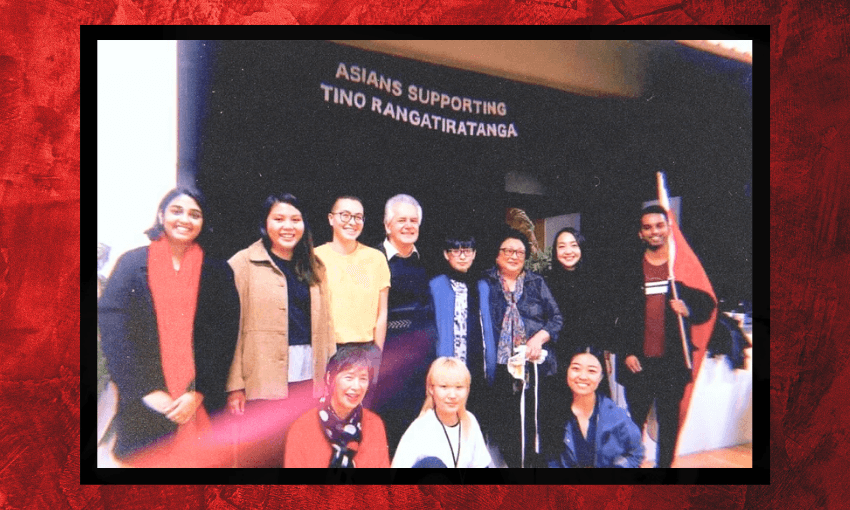
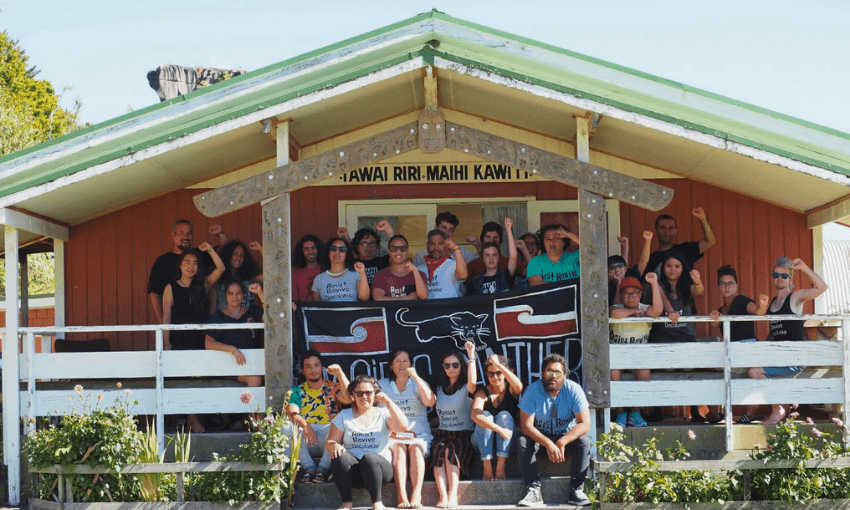
At Waitangi commemorations 10 years ago, a group of six held a banner proclaiming “Asians Supporting Tino Rangatiratanga”. It caught the attention of many in attendance and on social media, sparking the beginnings of a group that would come to be known as Asians Supporting Tino Rangatiratanga (ASTR). Since then, we have grown into a national movement, advocating for Māori rights, supporting various indigenous kaupapa, and educating people about te Tiriti o Waitangi.
Remembering our roots
Relationships of solidarity between Māori and Asians in Aotearoa go deep into our history: from South Asian sailors in the early 1800s marrying into Māori families and assisting Kāi Tahu to fight European colonisers, to Māori and Asian communities working together on and forming families on market gardens, to the stories the late Moana Jackson shared of Māori and Chinese solidarity.
“The garden is a special place because you have to really toil, right? You got to get out there, pull out the weeds. You have these wonderful moments of harvesting, and eating, and being together,” kaupapa Māori researcher Jenny Lee-Morgan said during our recent webinar marking our anniversary.
If the work of our group was a māra, its beginnings were seeded by friendships, chance encounters, social justice movements, Asian feminist community-building, and gifts of literature. These seeds were germinated by the nurturing from Jackson, Green party co-leader Marama Davidson, and many other supporters. We also stand on the shoulders of many Asian elders and activists who have built relationships and advocated for te Tiriti before us. These intergenerational relationships nurture and ground us in what we do.
Inspired by Jenny Lee-Morgan’s Jade Taniwha and Wai Ho’s Mellow Yellow zine, the first Asians Supporting Tino Rangatiratanga banner was taken to Waitangi in 2010. This banner was later used by Young Asian Feminists Aotearoa (YAFA), a social support network where relationships were built prior to the establishment of ASTR. This was during a period where various kaupapa – the Idle No More movement, the Occupy movement, state-housing evictions in Glen Innes – were all taking place.
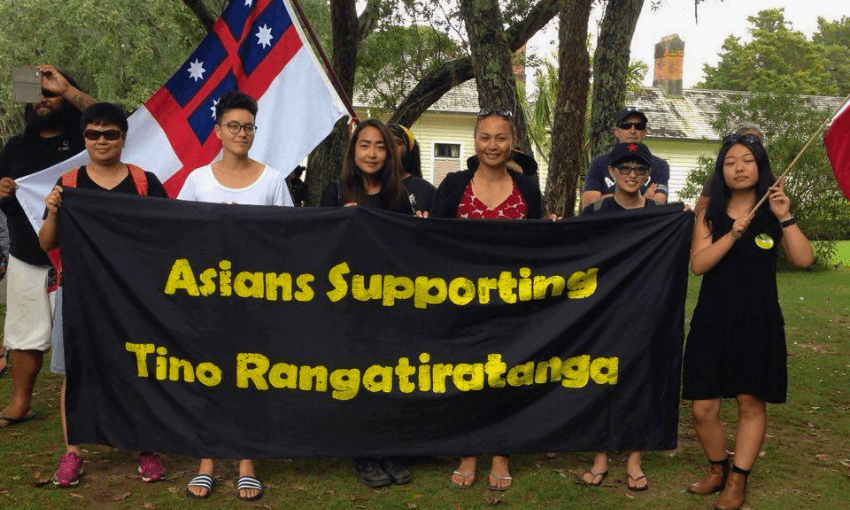
In 2016, Marama Davidson shared a photo of us with our banner at Waitangi on social media, and the response from tangata whenua was tremendously encouraging. There were six of us – Kirsty Fong, Mengzhu Fu, Bikun Li, Amenda Quang, Aram Wu and Julie Zhu – and we decided it was time to get organised to bring our communities towards honouring te Tiriti. We came up with two streams of work: showing up with Māori-led movements, and educating our own communities on Tiriti issues. We knew that Māori activists had challenged Pākehā to “educate their own” to take the burden off Māori, and in the same vein, we had a better chance of reaching our communities.
When we honour it, te Tiriti is a framework for meaningful relationships and belonging, and we wanted to intentionally engage with our communities, with te Tiriti as a basis of learning and connecting. With guidance from Tangata Tiriti – Treaty People and matua Moana Jackson, we started delivering workshops to our communities. In 2014, some of us had met Trish Cheng and Sue Gee at a treaty workshop at Auckland Chinese Community Centre. They have been aunties to ASTR, and they supported our first pilot workshop in 2016, where we expanded on the Tiriti workshop from Tangata Tiriti – Treaty People to include the history of racist immigration policies and Asian immigration. We were learning as we went along.
Te Tiriti o Waitangi is often framed as an issue between Māori and Pākehā. This means that many Asians don’t see the relevance of te Tiriti in our lives. At the same time, politicians weaponise “multiculturalism” and our migrant identities to undermine Māori and Treaty rights. Having experienced New Zealand’s anti-Asian racism, we refused to be used to deny Māori rights.
Many social justice movements are woven into our story: anti-war, feminist, migrant and refugee justice, anti-racist, union, environmental justice, LGBTQIA+, housing justice and animal rights movements. All roads led to confronting colonialism in Aotearoa. Through these movements, we met Māori activists who taught us the truths about He Whakaputanga, te Tiriti, and ongoing colonialism – truths obscured in New Zealand’s education and immigration systems. These relationships helped us understand our place and role as tauiwi.
Relationships at the heart of solidarity
“The heart of all this has to be the relationships between us as people,” Lee-Morgan said during the anniversary webinar.
Activist Aaryn Niuapu reminded us how Jackson emphasised mahi tūhono, relational activism. Our relationship with Racial Equity Aotearoa, which Niuapu founded with Alesha Hulme-Niuapu, modelled this. Since we met them in 2016, they have showed us what Aotearoa could look like if migrants of colour were met with manaakitanga, whanaungatanga and tino rangatiratanga-shaped immigration processes, and te Tiriti was honoured. This contrasted the racial violence and hostility many of us experienced growing up in Aotearoa. These relationships grew and some of our members became active in groups like Racial Equity Aotearoa and the Pacific Panther Network.
In 2018, our relationship with Jackson led to the formation of ASTR Pōneke. On a rainy evening, he told an audience of mainly Asian people: “Te Tiriti o Waitangi, for me, welcomed people from somewhere else onto our marae. You are welcome. You can live your lives as who you are. But this is the basic kawa: that you will respect the rights of others, you will respect the land, and you will work together to make this a better place.”
His kōrero – and stories of early Māori and Chinese solidarity – prepared the soil for ASTR Pōneke. Since then, it has collaborated with local organisations to protect Ihumātao, defend Māori wards, support Waitangi Day events and the Toitū te Tiriti hīkoi, and co-host submission parties with the African Diaspora for Indigenous Rights.
In 2022, ASTR Ōtepoti began with a potluck at activist Sina Brown-Davis’s house. Two years later, as government assaults on Māori ramped up with the Toitū te Tiriti activations in response, the banner of ASTR Ōtautahi became a lightning rod that gathered Asians together. Within ASTR, we learned to lean on each other, ask questions without shame, and collectively grow our confidence.
In July 2024, through our friend and activist Kassie Hartendorp, we connected with Asian organisers in an Australian advocacy group, Democracy of Colour. We learned from their experiences of the Voice referendum as we prepared to mobilise our communities against the Treaty principles bill. We expanded our networks to Turtle Island and Taiwan, striving for transnational solidarity against colonialism wherever it exists.
Today, as we face ongoing challenges, Hulme-Niuapu reminds us “the antidote is community, relationships, whanaungatanga”.
Anyone can do this mahi – there is space for everyone who is willing to show up. Collectives help us grow and keep us honest. Solidarity and activism can be joyful, fun, and creative. This mahi has built lifelong friendships.
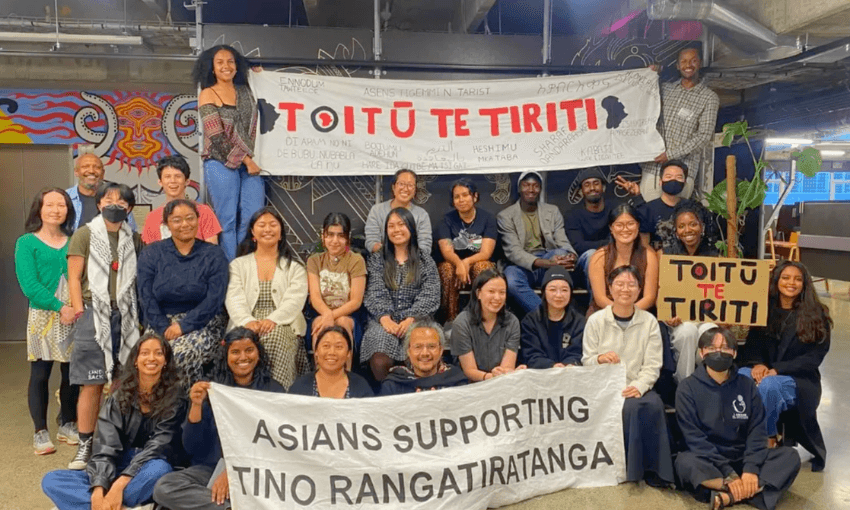
When we organise collectively, we pool our knowledge, resources and capacities to, in the words of Jackson, “work together to make this a better place.” We can support our communities to honour te Tiriti, respect the land and the rights of others. We can hold each other accountable to be respectful manuhiri on the marae that is Aotearoa.
We can reimagine a future based on the values and visions of Matike Mai Aotearoa. As treaty educator Tāwhana Chadwick pointed out in the webinar, it’s not “necessarily the plants that we worry about, but it’s the soil. Because it’s the soil we can have an impact on today for whatever grows in the future.”
Let us continue to give back to the whenua that has nourished us and draw on our collective imagination to usher in a liberatory future for all.