How to write with optimism when the waves are coming

How do you generate optimism when you’re drawn to, and living in, a dystopia?
Made possible by
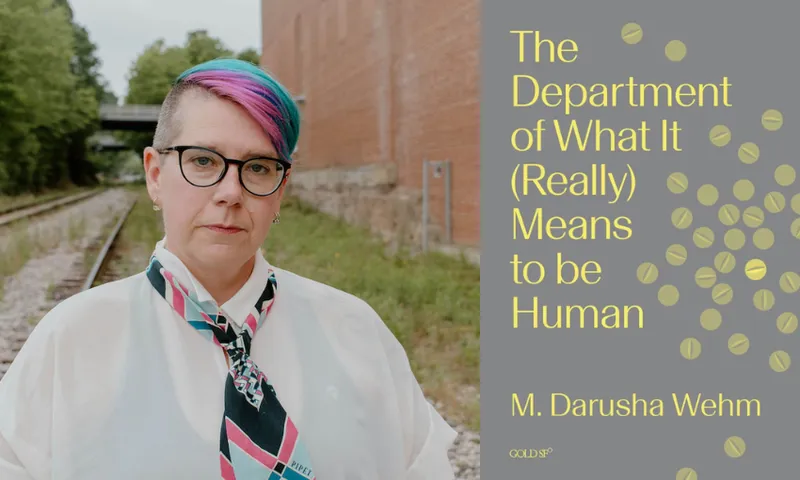
M. Darusha Wehm, author of ‘optimistic sci-fi novel’ The Department of What It (Really) Means to be Human, considers what it means to write in the time of the climate crisis.
All of the excerpts in this essay are from Wehm’s novel The Department of What It (Really) Means to be Human.
The cicadas are singing to me as I sit at my keyboard, a soundtrack that plays off and on throughout summer. A summer that reminds me more of the time I spent living in the hot, humid tropics than the temperate Te Whanganui-a-Tara Wellington I found when I arrived here 15 years ago. At least we still have the wind. Wellington is comfortable enough, even now.
We’re lucky here. We’ll be comfortable longer than many other places will, but I don’t really like being sticky. Our proximity to the ever-encroaching sea worries me, too. I have a recurring stress dream about watching a tsunami roll over the airport and subsume Evans Bay, but I know that’s not the more likely danger. Incremental change is what gets us, the apocryphal boiling frogs. I can’t help but wonder what it will be like here in a few years, another decade. Maybe we’ll find ways to push back the wave, make lemonade from the lemons.
I like to write fiction about a future that has at least a kernel of hope within it. It forces me to imagine better-case scenarios, which isn’t necessarily my first instinct.
The classic old villa had been saved by the damming of the harbour mouth, and the five of them worked hard to keep it up. It was a beautiful building and the nearby beach was great for swimming on the days the wind wasn’t up.
Climate change isn’t the point of that story. It’s just there in the background, a part of the landscape.
These are perilous times for working writers, but one thing remains true: writing is resilient. You can do it anywhere, with minimal equipment. I’ve worked on books on lunch breaks at an office job, in the galley of a boat in a heaving sea, on a beach under a straw umbrella, in a tent in the rain. No matter the weather, you can write. It’s not like fishing or landscaping or working a food truck, where the answer to “what’s it like out” makes the difference between getting paid or not.
In addition to my solo work, I often collaborate with other authors. I’m currently a part of a five-person team called Darkly Lem and for the past few years we’ve met online to write together a couple of times a week. Recently, I didn’t see the face of one of my co-writers in months, because his camera shuts off when it overheats. Another member of that team has missed several meetings due to surprise childcare duties on the increasing number of snow days. They apparently just don’t have the infrastructure to handle so much snow in North Carolina. Who would have guessed?
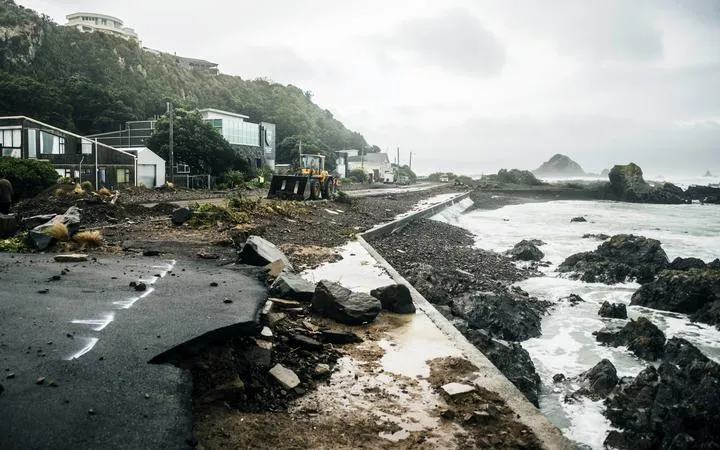
Here at home, the start of my friend’s residency is postponed due to a storm that means half of Wellington can’t get into town. We’ll celebrate some other day, instead. We make do. We’re not like the transport staff who can’t work, or the commuters who can’t work from home. We’re resilient.
Anya padded into the common room in shorts and a singlet, her feet bare. This was the hottest summer on record according to Metservice, the temperatures well into the thirties most days.
Climate change isn’t something we think about when my colleagues and I plan our work. It’s just there, in our chit-chat about the weather, driving the storms that knock out the internet, influencing how we manage our days.
Being drawn to dystopia is natural in difficult times. But to my mind, at this exact moment in history it feels liberating, even radical, to imagine a better future instead. I find it easy—rational, even—to be pessimistic, but if you can’t picture the world in which you want to live, you can’t build it. The future is a house we are building together, and it needs architects as well as joiners.
I believe that stories are one of the tools we use to create the future. I think about the future I would create for myself and my community and I tell myself the story of what I’d like my life to be. Knowing my interests, it will probably be science fiction. But even if the world I most would love to live in can’t exist in my own lifetime, in telling myself the story I’ll learn what I want from the world that exists now.
After all, knowing what you want is the first step to making it happen.
Outside, the afternoon sun was bright and the air was hot. They were aware of all the people around them, the noise of the city. The world felt suddenly large and full of possibilities, positive and negative. Em and Anya walked towards the waterfront, watching as a sea cleaner made its ponderous way toward the lock at the harbour mouth.
There’s this old chestnut where “talking about the weather” is shorthand for the most dull, banal conversation a person can imagine. Do kids these days still think that? I don’t even think I think that, and I’m old enough to use the phrase “kids these days.”
When I was a sailor I was, appropriately, obsessed with the weather. I always knew what the forecast was, the direction and force of the wind, the size and period of the ocean swell. When I met up with other folks on the water, we all talked about the weather. It was the most interesting topic going. When I moved ashore it took years to lose that habit, but now I feel the old itch to know coming back. The days aren’t predictable anymore and, even in my comfortable city, in my comfortable life, I’m not isolated from the changes happening all over the world.
Hundred-year storms. Solar farms. Landslides. Sea walls. Heatwaves. Carbon sequestration programmes. Crop failures. Emissions reductions.
Our choices and their consequences are always there, in the background of every day. Relentlessly there, like the cicadas outside my window. I thought the storm would put an end to their song, but no. The next day they are still there, screaming away. They are resilient, too.
I wonder what their song will be like decades from now. Will they change or will we?
The Department of What It (Really) Means to be Human by M. Darusha Wehm (Gold SF) can be ordered from Goldsmiths Press and The Nile.
The Spinoff Books section is proudly brought to you by Unity Books and Creative New Zealand. Visit Unity Books online today.

Darusha Wehm
M. Darusha Wehm is the Nebula Award-winning and Sir Julius Vogel Award-winning author of over a dozen novels, several poems, many short stories, and some games. Originally from Canada, Darusha now lives in Te Whanganui-a-Tara after several years sailing the Pacific.


